| |
|
|
|

|
| |
|
|
| Bora Bora. |
Top Bora Bora Attractions
The first time you visit Bora Bora, or any new destination,
the question asked isn’t usually what attractions should be
scene but what attraction to see first, what to expect, how to get
there, and how much time is needed. We’ve provided tips, advice,
and other information about the top tourist attractions in Bora Bora
to help with your itinerary planning.
|
|

|
Matira Beach
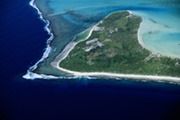 Matira
Beach at Bora-Bora's southern tip is the best and most popular on
the island. A classic example of a South Pacific beach, its white
sand stretches from Hotel Bora Bora to Matira Point. Topless sunbathers
enjoy the tranquility of the beach while being cooled by the trade
winds. At the eastern edge of Hotel Matira, a walking trail runs
up to a battery of WW II coastal defense guns. Matira
Beach at Bora-Bora's southern tip is the best and most popular on
the island. A classic example of a South Pacific beach, its white
sand stretches from Hotel Bora Bora to Matira Point. Topless sunbathers
enjoy the tranquility of the beach while being cooled by the trade
winds. At the eastern edge of Hotel Matira, a walking trail runs
up to a battery of WW II coastal defense guns.
At low tide, you can wade from the end of Matira Point all the
way to the barrier reef. It is this shallow water that prevents
yachts from sailing around the island inside the reef.
Bora-Bora's shallow lagoon is better suited for snorkeling than
scuba diving. You can find some of the island’s best snorkeling
right off the point at Hotel Bora Bora. Home to nearly 700 tropical
fish species, giant manta rays and sharks, the amazing blues and
greens of the Bora Bora lagoon are just crying out to be explored.
As manta rays glide gracefully below you, smaller fish approach
you easily as they are accustomed to being fed. Head south toward
the northern edge of the barrier reef for a more natural setting,
but beware of glass-bottom boats rowing by.
Another water activity to enjoy at Matira Beach is to kayak or
outrigger canoe toward the channel between two small motus just
offshore. You will discover a coral garden overflowing with tropical
fish. Hop into the water and let the current carry you through.
|
Bora Bora Lagoonarium
 |
| Address |
Po Box 234 Bora Bora 98730 |
|
| Admission |
Full day tour: $94.00 USD per person. Half-day
morning tour: $72.00 USD per person. Half-day afternoon tour:
$61.00 USD per person. Half-price for children 3-10 years old.
Tip: print out the 10% savings coupon posted on their web site
before reserving your package. |
|
| Hours |
Open Sunday – Friday. Closed on Saturdays. |
|
| Phone |
+689 67 71 34 |
|
| Website |
http://www.boraboraisland.com/lagoonarium/ |
|
|
|
In the heart of Bora Bora’s famous turquoise-blue lagoon,
the Lagoonarium is an outdoor aquarium where the colorful fish and
marine life of the lagoon swim about. But instead of being on the
other side of the glass like a traditional aquarium, you are invited
to grab a snorkel and mask and jump in to swim amongst the turtles,
sharks, rays and other tropical fish of the lagoon. Safe for all
ages, experienced guides will show you how to touch and interact
with the sea life. Guides also demonstrate their expertise in the
daily shark and ray feeding exhibitions.
The Lagoonarium offers three tour options:
The full-day tour runs from 8:45am until 3:30pm and includes several
hours of exploring the Lagoonarium at your leisure with the shark
and ray feeding exhibition in the afternoon. An outrigger canoe
will take you on a full circle island tour and you will get to snorkel
in the Bora Bora Coral Gardens. The tour also includes a barbecue
picnic of traditional fish and chicken dishes held on a private
motu.
The half-day morning tour runs from 8:45am – 12:30pm and
includes all activities listed above, but without the barbecue picnic.
The shorter, half-day afternoon tour runs from 1:00pm to 3:45pm
and provides a few hours of swimming in the Lagoonarium.
|
Ancient Marae Temples
It is believed that the first signs of human life on Bora Bora
dates back to 900 A.D. These ancient Polynesians once called Bora
Bora “Mai Te Pora,” which literally means “created
by the Gods.”
Because of its mystical past, about 40 traditional open-air stone
temples or maraes, still exist on the island. Like in the other
Leeward Islands, Bora Bora's marae are not enclosed, and their large
altars are raised, smooth coral platforms. The Polynesians used
the temples for religious and cultural ceremonies such as presenting
the gods with ritual gifts of fruit and other foods, celebrating
weddings and victories, or enthroning a king.
Most notably, the Marae Fare-Opu, is located on the west coast
of the island just before Faanui Village and situated between the
roadside and the water’s edge. Carved into two of the stone
slabs of the marae are petroglyphs of turtles. The animal was sacred
to the ancient Polynesians and other turtle petroglyphs can be found
at many other sites throughout the Society islands. It is said that
the animal may have been a favorite ritual offering to the gods.
Continuing south along the west coast, you will come upon the fairly
large Marae Taianapa on the inland side of the road just past Faanui
Village. Traveling west along the same coastal road, you will pass
Farepiti Wharf where the inter-island boats dock in Faanui Bay.
The Marae Marotetini lies just beyond the wharf. This fine example
of an ancient temple was restored by Dr. Yosihiko Sinoto in 1968.
Two more marae can be found on the eastern side of the island just
above Fitiiu Point. Off the road at the water’s edge, Marae
Aehua-tai faces Vairau Bay, while Marae Taharuu faces the northern
Haamaire Bay.
Contact the Bora Bora Visitor Center (tel: +689 67 76 36) for further
information concerning these sites.
|
Tupuna Safari 4x4
|
| Address |
BP 56, Vaitape |
|
| Admission |
A 3-hour tour costs $65.00 USD per person.
They also offer a 50% discount for children under 12 |
|
| Hours |
Two departures daily: Depart at 8:30 am and return at 12:00
noonDepart at 1:30 pm and return at 5:00 pm |
|
| Phone |
+689-67-75-06 |
|
| Website |
www.boraboraisland.com |
|
|
|
One of the best ways to explore the island is by jumping into a
four-wheel-drive vehicle. Tupuna Safari 4x4 will take you on a fully-guided,
3-hour excursion all over the island in one of their comfy Range
Rover 4x4's. As you will drive along the rugged coastline you will
notice Bora Bora’s tropical floral-life like the hibiscus
that lines the hills and valleys and the coconut palm trees that
dominate the landscape.
Locals serve as tour guides and provide riders not only with the
facts, history and politics of Bora Bora, but also of the traditional
ways of Polynesian life.
The tour includes stops at American World War II sites, including
cannons that may be hard to find without a tour guide in tow. Four
of the most popular of these naval cannons are located at panoramic
points on the island where you can take photographs of the dazzling
seascape below.
The tour also stops at ancient stone temples (marae) and other
archaeological sites on the island.
|
Traditional Polynesian Dance
Traditional Polynesian song and dance is inspired by the ancient
legends and folklore passed down from their gods. Officially banned
following the religious conversion of the late 19th century, It
was the onset of tourism in the 20th century that helped to revive
these traditional customs.
A traditional female dancer was wrapped in tapa (a fabric made
from pounding and softening tree bark) decorated with feathers,
shells and mother of pearl. The costumes of today’s female
dancers include a more (or skirt), a belt and a bra made of seashells
or coconut shells. Male dancers also wear a more, a belt and a large
headdress. Dancers hold feathers or pompoms to accentuate their
moves and move to the beats of a variety of drums, nasal flutes,
conch shells and ukuleles.
There are 4 major types of traditional dances:
- otea - a war dance where a group
of dancers line up in rows and are accompanied with percussion
- hivinau - dancers move in circles
to the beat of drums and sing in unison to answer a male soloist
- aparima - danced in rows, scenes
of daily life are mimed and accompanied a guitar, ukulele and
vocals
- pao’a - a sensual dance, a
couple dancers improvise in the center of a half-circle while
the other dancers sit on the ground clapping to the beat.
Traditional dance performances are held at many of the world-class
resorts throughout the island. At the exclusive Hotel Bora Bora
(Tel: +689-60-44-60), a weekly feature is traditional island singing
and dancing, with sunset cocktails at the Pofai Beach Bar. At the
luxurious Moana Beach Parkroyal (Tel: +689-60-49-00), there are
folkloric shows three times a week and a Tahitian trio performance
nightly on the terrace. Many other hotels also offer traditional
Tahitian dancing and singing, so ask at the reception desk for costs
and schedule.
|
Bora Bora Travel Guides
 Frommer's Bora Bora Frommer's Bora Bora
Lonely Planet Bora Bora
Let's Go Bora Bora
Fodors Bora Bora
|
|
|
|
|
|
|
|
|
|
|
|
|
|
|
|
|
|